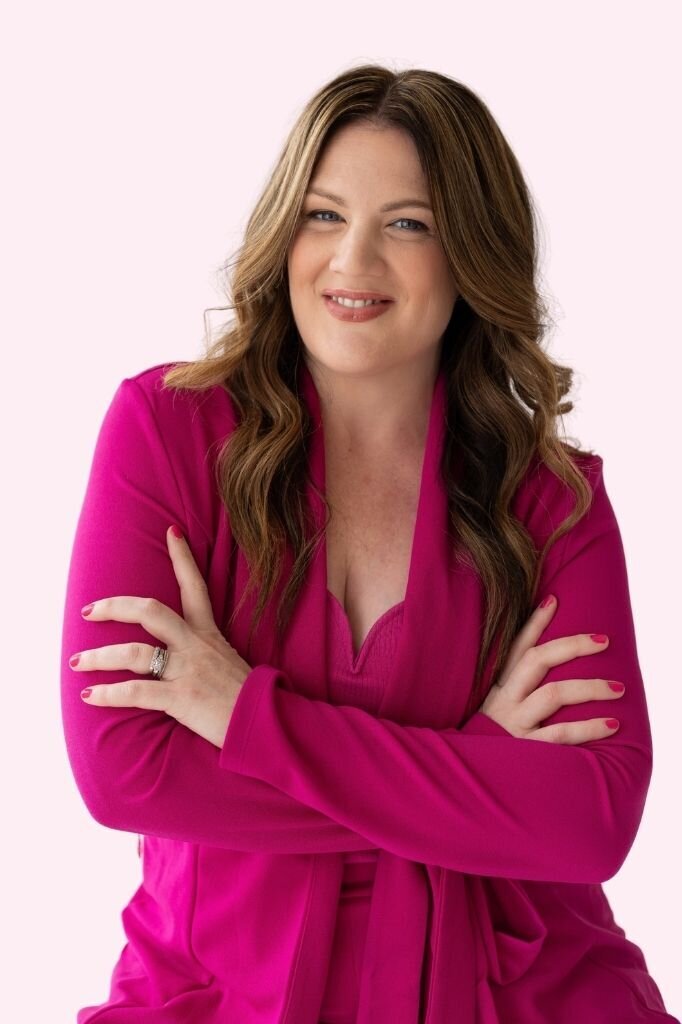
Most brand designers will tell you what colours your logo should be. Emily Dick first asks who you are underneath all the social conditioning. She is the founder of Unbuttoned Brands, a bold brand strategy and design studio in Burlington, Ontario, that builds identities for values-driven entrepreneurs — therapists, coaches, healers, consultants and creatives — on one conviction: Being Yourself is the Strategy™.
A sociologist by education, an author by accident, and a late-diagnosed AuDHD entrepreneur by self-knowledge, Emily built her first personal brand because a literary agent told her she had no choice. Today her studio helps sensitive, high-achieving founders stand out without burning out, at a moment when women-owned businesses are growing faster than ever.
Table of Contents
- From Sociology and Gender Studies to Brand Strategy
- The First Brand She Built Was Her Own
- From Bootstrapped Woman to Unbuttoned Brands
- The Marketing Pivot: Leaving Social Media Behind
- Building a Business Around an AuDHD Brain
- What She Is Most Proud Of
- Advice for Newer Founders
- What's Next for Unbuttoned Brands
- Frequently Asked Questions
From Sociology and Gender Studies to Brand Strategy
Emily Dick did not go to school for marketing or design — she studied sociology and gender studies, and that background is exactly what her branding work runs on. "I never imagined that learning about people and power would lead me to brand strategy and design, but looking back it makes so much sense," she says. Sociology gave her the ability to see patterns of identity and to ask why a system looks the way it looks before trying to change it.
Her route was winding. She started as a coordinator at a mandated workplace counselling company, then moved into the family business in restaurant operations and marketing, gaining an operator's view of how a brand actually moves a small business. Writing and freelance creative work ran alongside, until she opened a photography studio and several freelance businesses before leaving the steady job for full-time entrepreneurship.
She now leads into a fast-growing market. Majority women-owned businesses accounted for 20% of all Canadian businesses at the beginning of 2025, up from 17.6% a year earlier, and majority women-owned SMEs generate more than $90 billion in annual revenues while employing close to one million Canadians, according to the Women Entrepreneurship Knowledge Hub's 2025 State of Women's Entrepreneurship in Canada report.
The First Brand She Built Was Her Own
The first brand Emily Dick ever built was her own, and a literary agent made her build it. "I built my first online platform because a literary agent told me I had to if I ever wanted to publish my book," she explains. "I had one option, to figure it out. I built my first personal brand and landed a traditional book deal and grew a following of thousands."
What she stumbled into was search optimisation before she knew it had a name. She wrote blog posts that answered real questions people were already asking online. That content built authority and created what she calls "digital breadcrumbs" leading back to her work, enough to land interviews with major publications. By the time she pursued publishing, she was not just someone with an idea; she had an audience and proof of engagement.
That experience taught her a lesson she now sells: a personal brand is not a vanity project, it is infrastructure. In the 2016 Impact of Brand Consistency study by Demand Metric and Lucidpress, organisations with inconsistent brand presentation estimated that always presenting the brand consistently would raise revenue by an average of 23%, and consistently presented brands were three to four times more likely to enjoy excellent brand visibility.
From Bootstrapped Woman to Unbuttoned Brands
Unbuttoned Brands is the studio's second name, and the rename was a values decision rather than a marketing one. Before Unbuttoned, Emily ran Bootstrapped Woman, a brand she built independently to support other women doing the same. Then a post caught her attention about how phrases like "getting money into women's hands" can unintentionally exclude non-binary and gender-expansive people.
She started with small shifts — updating the language on her website to be more inclusive. "But the more I sat with it, the more I realized the name itself no longer reflected the direction I wanted to move in," she says. Unbuttoned Brands emerged in August 2023 as a trading name of her incorporated company, Real Happy Daughter Inc. The core of the work did not change; who she intentionally creates space for did.
The decision had a real price: rebranding meant undoing years of accumulated backlinks and search authority, leaving her new domain with, as she puts it, "baby SEO authority." She frames it as proof of priorities — her values matter more than acquiring clients. It is also the kind of consistency premium the numbers reward: Lucidpress's 2019 State of Brand Consistency report found that consistent branding can increase revenue by up to 33%, while 81% of companies still dealt with off-brand content.
The Marketing Pivot: Leaving Social Media Behind
Emily Dick stopped feeding her social media feed, and her business grew. When Unbuttoned launched, social media was her primary marketing channel. What she eventually realised was that most of her clients were not coming from it at all. About a year ago she replaced her Instagram feed with a static nine-post grid and redirected her energy to email marketing and SEO.
"Not only did this reduce burnout, but my business really started to grow because I was focused on things that were actually working," she says. For email she uses Kit, formerly ConvertKit, relying on automations such as welcome sequences and her brand quiz results. Email remains the highest-return channel for a solo studio: Litmus's State of Email 2025 reports an average return of $36 for every $1 spent, with 35% of companies seeing returns between $10 and $36 per dollar.
This magazine has seen the pattern before: founders like Victoria Repa of BetterMe and Kristy Kim of TomoCredit built audiences by treating owned channels and clear messaging as assets rather than chasing every platform. "Marketing is about constantly experimenting and tending," Emily says, "but I learned that it shouldn't feel unsustainable."
Building a Business Around an AuDHD Brain
Emily Dick is AuDHD — autistic and ADHD, diagnosed later in life — and she runs her studio around that reality instead of against it. "I have become very aware of the ebbs and flows of my energy," she says. She books client meetings on extroverted days such as her twice-weekly Pilates mornings, keeps creative and administrative days clear, and recently added a calendar layer she toggles on and off to track her menstrual cycle.
Her productivity systems are external by design. "If I don't write something down, it does not exist," she says. She brain-dumps every idea and task into lists — her "brain scramblies" — and organises her to-dos in Google Tasks by priority: revenue and reputation first, then brand visibility and authority building, then admin. Her best ideas, she says, arrive when she is rested, which is why she protects rest rather than squeezing it out.
She is far from alone in building a company this way. A large-scale study of 9,869 individuals published in Small Business Economics in 2019 found that adults with a clinical ADHD diagnosis were roughly 1.7 times more likely to report entrepreneurial intentions, and that ADHD nearly doubled the odds of actually starting a venture. The authors caution that venturing and performance are not the same thing — but designing for your own neurotype turns a liability into a working method.
What She Is Most Proud Of
Emily Dick is most proud of what her business stands for, not of any single client win. "Getting to work with people who help people feels like the best way to make an impact," she says. "Helping values-driven entrepreneurs stand out and get chosen means more money in the hands of people who will invest in their families, communities, and causes they care about."
That framing makes Unbuttoned more than a design studio: every brand she builds is a small bet on a values-driven founder having the resources to keep doing their work. She extends the argument beyond clients, too. "I genuinely believe that a more matriarchal, community centered world would be healthier for all of us," she says, defining that as a system centring children, care, community and sustainability — not women ruling over men.
The bet is well timed. Women own 15.7 million businesses in the United States — 40.6% of all US businesses — a 12.1% increase between 2022 and 2025, according to the 2026 Impact of Women-Owned Businesses report commissioned by Wells Fargo. Those firms employ roughly 12.6 million people and generate $2.8 trillion in revenue, yet most women-owned businesses still never cross $1 million annually. Visibility is one of the real bottlenecks — precisely what Unbuttoned sells against.
Advice for Newer Founders
Emily Dick's advice to newer founders is two words: just start. "Too often we delay trying something new because we are afraid of failure," she says. "Entrepreneurship is never about getting it right the first time. Things are always changing, just like we are."
The second half of her advice is about unlearning. "I didn't realize how much unlearning you end up doing as an entrepreneur," she says, wishing she had known that figuring out what does not work is as valuable as finding what does. When you are new, you absorb everyone's methods; success is partly learning what works for your life, your energy levels and your neurotype. Asked what she would tell her younger self: trust yourself sooner. "What works for someone else might completely drain you."
She also refuses to treat setbacks as verdicts. "I don't really see failures as failures. I see them as redirections," she says — offers that did not stick and strategies she felt she "should" pursue each taught her something about her energy, her values, or what she genuinely enjoys.
What's Next for Unbuttoned Brands
The next chapter is the same shape as the current one, only bigger: more values-driven entrepreneurs, more bold brands that feel unmistakably like their founders. Emily is investing deliberately in the channels that already work — backlinks, SEO and email marketing — and has hired outside help, including an SEO expert and a virtual assistant.
She is also building what she calls a foundation rather than just a presence. She recently invested in a trademark search through Sprout Law before moving forward with US trademark work, protecting the business name and the tagline that carries the positioning. And she keeps writing: the author thread that brought her into entrepreneurship continues through interviews, newsletters and SEO-informed blog posts that answer the exact questions her ideal clients ask.
The strategy is the same one she sells. Be clear about who you are, say it everywhere consistently, and let the right people find you — without hustling yourself into the ground. As she tells clients waiting to feel ready: you are ready now. Branding is not the reward for success; it is the tool that helps you build it.
Frequently Asked Questions
Who is Emily Dick?
Emily Lauren Dick is a Canadian brand strategist, designer and author based in Burlington, Ontario, and the founder of Unbuttoned Brands. She helps values-driven entrepreneurs — mostly coaches, therapists, healers, consultants and creatives — build bold brand identities that feel like a natural extension of who they are.
What is Unbuttoned Brands?
Unbuttoned Brands is a brand strategy and design studio founded in 2023 and operated as a trading name of Real Happy Daughter Inc. It offers positioning, messaging, visual identity and website design for service-based businesses that want to stand out without burning out.
What does "Being Yourself is the Strategy" mean?
It is Emily's trademarked philosophy: instead of copying a competitor's playbook or leaning on generic formulas such as colour psychology, a brand should be built on who the founder actually is — voice, values and quirks included. The premise is that authenticity, made visible and consistent, is what attracts the right clients.
Why did Emily rename Bootstrapped Woman to Unbuttoned Brands?
She wanted a name that was more inclusive of non-binary and gender-expansive entrepreneurs. After updating the language on her website, she realised the old name itself no longer matched her values, so she rebranded — even though it meant giving up years of accumulated SEO authority and backlinks.
How does she market without social media?
Emily replaced her Instagram feed with a static nine-post grid and shifted her effort to email marketing, SEO and long-form content. She uses Kit (formerly ConvertKit) for welcome sequences and brand-quiz automations, and publishes blog posts designed to answer the exact questions her ideal clients search for.
What is AuDHD, and how does it shape her business?
AuDHD refers to being both autistic and ADHD, a combination Emily was diagnosed with later in life. She designs her schedule around it: meetings clustered on extroverted days, creative work on clear days, brain-dump lists for focus, and a menstrual-cycle calendar layer to plan around her energy.
Conclusion
Emily Dick's story is not a straight line from a sociology degree to a design studio — it is a demonstration that the off-path route can be the strategy. A degree became a research method. A book launch became a personal brand. A rebrand that cost her search authority became proof that her values are not decoration. And a decision to stop posting became the growth channel that actually works.
For values-driven founders, the lesson is portable: clarity about who you are compounds, in search rankings and in trust alike. Emily Dick is building a studio on that compounding — one bold, unmistakably-you brand at a time.
Sources
- IdeaMensch, Interview with Emily Dick, Founder of Unbuttoned Brands, February 19, 2026.
- Entreprenista, How Emily Dick Built Unbuttoned Brands, May 27, 2026.
- BoldJourney, An Inspired Chat with Emily Lauren Dick, 2025.
- Unbuttoned Brands, About page (official website, accessed October 2026).
- Medium / Authority Magazine, The New CEO Playbook: Emily Lauren Dick of Unbuttoned Brands, 2025.
- Women Entrepreneurship Knowledge Hub (WEKH), The State of Women's Entrepreneurship in Canada: 2025, Toronto Metropolitan University.
- Demand Metric and Lucidpress, The Impact of Brand Consistency, November 10, 2016.
- Lucidpress, State of Brand Consistency Report, December 2, 2019.
- Litmus, The State of Email 2025: Email Marketing ROI, 2025.
- Verheul et al., "Entrepreneurship and attention deficit/hyperactivity disorder: a large-scale study involving the clinical condition of ADHD", Small Business Economics, 2019 (doi:10.1007/s11187-018-0061-1).
- Wells Fargo, 2026 Impact of Women-Owned Businesses report, as reported by Bizwomen, September 11, 2026.