A remote book club is one of the few businesses a woman can start in 2027 with a reading habit, a calendar link and no inventory. You are not selling books; you are selling a scheduled reason for busy adults to finish one and talk about it with people who care. That is a subscription product, and it runs from a laptop in a few hours a week.
The hard part is already solved: readers exist in volume, the tools are cheap, and the biggest mass-market player in the category has just walked away. What remains is execution — a narrow audience, a repeatable format, honest pricing and a retention habit strong enough to survive month four.
Table of Contents
- Why a Remote Book Club Works as a Business in 2027
- Choose Your Niche and Format Before You Name the Club
- Design the Membership Tiers and Price Them
- Pick a Platform You Can Grow Into
- How to Get Your First Fifty Paying Members
- Build Revenue Beyond Subscriptions
- Retention Is the Business
- Operations, Billing and Legal Basics
- The Numbers: A Realistic First-Year Model
- Frequently Asked Questions
Why a Remote Book Club Works as a Business in 2027
A remote book club works as a business because it turns a free social ritual into a recurring payment with almost no cost per additional member. Your marginal expense for member 101 is a seat on a video call, not a box of goods.
Demand is large but shallowly served. Pew Research Center found that 75% of U.S. adults read all or part of a book in the previous 12 months, while only 7% had joined a book club in that period, per its October 2025 survey of 8,046 adults. Millions of readers already do the activity and never join the social version of it; the barrier is friction, scheduling and the fear of showing up alone.
Money moves through the category: the Association of American Publishers put U.S. publishing revenue at $33.4 billion for calendar year 2025, with trade books at $21.7 billion and digital audio at $2.5 billion, up 5.3%. Publishers need engaged reader communities because discovery is the bottleneck.
Timing helps too. Amazon wound down Amazon Book Clubs on March 1, 2026, deleting members' clubs and content, as Amazon confirmed to Good e-Reader; the largest retailer in books exited hosted clubs. Independently run clubs now face no dominant incumbent, and the format travels: Silent Book Club reports nearly 2,000 chapters across 55+ countries.
Choose Your Niche and Format Before You Name the Club
A profitable remote book club is narrow enough that a stranger can describe it in one sentence, and structured enough that members know what happens each month. "A book club for women in their thirties rebuilding a reading habit" books better than "a community for book lovers."
Pick a niche by intersection, not genre alone: romance readers wanting closed-door recommendations, founders reading business nonfiction, memoir readers in midlife, parents reading twenty minutes a night. Then choose one primary and one secondary format so the calendar stays predictable:
- Live discussion — one 60-minute video call per book, same weekday and hour every month.
- Silent reading session — a 45-minute camera-optional sprint, then 15 minutes of talk, the mechanic behind Silent Book Club's growth.
- Author or expert Q&A — the premium event that justifies a higher tier.
- Asynchronous threads — chapter prompts for members in other time zones.
Run a four-week pilot before charging anyone: ten to fifteen readers, one book, one call, one feedback form. It exposes the real constraints — time zones, discussion quality, whether you enjoy hosting — at zero cost.
Design the Membership Tiers and Price Them
Charge from the first cohort, even if the amount is small, because free members do not behave like customers and will not tell you whether the product is worth paying for. A three-tier structure between $9 and $39 per month covers most reader audiences, with an annual option at roughly ten months for twelve.
A workable structure: a free tier with the monthly book announcement and one newsletter; a core tier around $15 with the live discussion, the vote and the replay; a premium tier around $35 adding author sessions, a small group of eight and a reading guide. Keep the core tier the obvious choice — premium tiers anchor value rather than carry revenue.
Readers are trained to pay for access. Patreon reports more than 10 million fans paying monthly across 300,000+ creators, plus 100 million+ free memberships. Its standard plan takes a 10% cut of creator revenue plus processing, per Variety's reporting on Patreon's 2025 earnings. Treat 10% as your benchmark: a platform charging more must earn it with distribution, not just hosting.
Pick a Platform You Can Grow Into
Choose the cheapest platform that supports paid memberships and video, then move only when a specific limitation costs you money. Most first-year clubs need billing, a calendar, a replay library and one place for discussion — not an all-in-one community suite.
Bookclubs is the lowest-friction start for a reading-first club: free management tools, and Pro Plus at $228 per year ($19 per month) adding integrated video meetings, member list export and the ability to charge a membership fee and sell event tickets. For a club built on books rather than courses, that is enough for year one.
If the community becomes the product, creator platforms are the next step. Circle's Professional plan is $89 per month billed annually with a 2% transaction fee, and Mighty's entry plan is $79 per month billed annually with a 2% fee, per their 2026 pricing pages. Both include member apps, events and payments; both also put your club inside someone else's interface.
Two rules: keep email as the spine, and never let the video tool drive the decision.
How to Get Your First Fifty Paying Members
Your first fifty members come from a warm audience plus one partnership, not from advertising. Paid acquisition usually costs more than a $15 subscription can recover quickly, so treat the first cohort as a hand-built list of people who already trust you.
Start with a free public event: one open discussion announced to your newsletter, your social audience and two local institutions. Independent bookstores and public libraries are the highest-yield partners here because they have reading audiences and no hosted-club product of their own; offer to run a monthly remote session under their name and split promotion. Silent Book Club's chapter model shows how far a repeatable format travels when local organizers carry it.
Then convert: at the end of the session, offer the paid club with a founding-member rate locked for twelve months, capped at 40 to 60 people before you need a second session. Ask anyone who says yes twice to pay annually; it funds year one and predicts who stays.
Build Revenue Beyond Subscriptions
Subscriptions should be 60% to 80% of revenue, with the rest from partnerships and affiliate income that add no hosting hours. Reader audiences monetize easily here because every discussion has a book at its center.
- Affiliate links. Bookshop.org pays 10% per sale; Libro.fm pays 10% on audiobooks and credit bundles plus 30% on new monthly memberships, per their published terms. Disclose the links plainly.
- Publisher partnerships. A sponsored read-along — books or a fee in exchange for a guaranteed discussion and a written summary — is the standard deal. Trade revenue hit $21.7 billion in 2025, and marketing budgets follow attention.
- Corporate clubs. One company club at a flat retainer can equal 20 individual members, with less churn and one invoice.
- Events and guides. Ticketed author evenings and a seasonal discussion guide monetize the same audience.
Keep sponsorship visibly separate from the reading list: one paid pick per quarter, labeled, protects the trust that makes the club sellable.
Retention Is the Business
Retention decides whether a book club becomes income or a hobby: a club losing 8% of members monthly halves within nine months. Recurly's benchmarks put median churn at 3.60% across its network, with 2.34% voluntary and 1.25% involuntary — failed card payments are pure leakage most operators ignore.
Four habits carry it. Keep the same time slot for a year so the club becomes a fixture. Let members host one discussion per quarter; ownership outperforms audience. Keep a replay library so a missed month does not feel wasted. Offer a one-month pause instead of a cancellation — paused members usually return, cancelled ones rarely do.
Track three numbers monthly: active members, churn, and attendance as a share of membership. Attendance below 30% is the earliest warning that the format, not the marketing, needs work.
Operations, Billing and Legal Basics
Register the business, separate the bank account, and put written terms in front of members before the first payment. A book club is a small subscription business, and the boring parts protect the fun part.
Use a processor that handles recurring billing, dunning and tax. Digital subscriptions can carry sales tax or VAT obligations that vary by jurisdiction and member location, so confirm the rules for your own country. Publish short terms covering billing date, cancellation, refunds and conduct, plus a one-paragraph moderation policy you enforce — the same discipline behind a freelance community management practice.
On copyright, discuss books rather than reproduce them: short quotations are normal, scanned chapters are not. If you host authors, get recording rights in writing. Caption replays and keep the camera optional; accessibility widens the audience and removes the "I don't want to be seen" objection.
The Numbers: A Realistic First-Year Model
A first-year club can plausibly reach $1,500 to $2,000 in monthly net income by month twelve at 150 members, assuming a blended $14 price and disciplined costs. These figures are arithmetic, not a forecast.
At 150 members and $14, gross revenue is $2,100. Platform and payment fees at 5% to 7% take $105 to $147, author honoraria for four quarterly events run $200 to $400, software and email add $30 to $90, and affiliate or sponsorship income of $150 to $400 offsets part of it. Net lands near $1,600 to $1,900 against 10 to 15 hours a week. Break-even sits around 35 members at $15, which is why the first cohort matters more than the launch.
Cost discipline is the lever: Bookclubs at $19 per month plus a video account handles 150 members, while an $89 or $79 platform with a 2% fee only pays off once events or courses generate revenue.
Frequently Asked Questions
How much should I charge for a remote book club membership?
Most reader clubs price a core tier between $10 and $20 per month, with premium tiers around $35 to $40 for author events and small groups. Start at the low end for a founding cohort, offer an annual plan at roughly ten months' price, and raise the core price only for new members so existing ones stay locked in.
Do I need a business entity to run a paid book club?
You can test the idea as a sole proprietor, but register a limited liability company or local equivalent before you collect recurring payments at scale. It separates personal and business liability, makes a business bank account possible, and simplifies how subscription revenue is taxed.
Which platform is best for a paid book club in 2027?
Bookclubs is the cheapest reading-native option at $19 per month on Pro Plus, which includes video meetings and the ability to charge membership fees. Circle at $89 per month and Mighty at $79 per month, both billed annually with a 2% transaction fee, make sense once you sell courses, run frequent events or need branded member apps.
How many members do I need before the club is profitable?
Around 35 members at $15 per month covers a lean cost base of platform fees, email, payment processing and occasional author honoraria. Profitability above that depends less on member count than on churn: at 5% monthly churn you need steady acquisition just to stay flat.
Can I run a book club without showing my face on video?
Yes. Camera-optional silent reading sessions, audio-only discussions and asynchronous chapter threads all work, and they lower the barrier for members who dislike being on camera. Recordings and written summaries become the visible product instead of your face.
How do I keep members past the third month?
Fix the schedule, give members hosting roles, keep a replay library and offer a pause instead of a cancellation. Onboarding in the first two weeks matters most: a personal welcome, a clear next date and one question about what they want to read predict whether they stay.
Conclusion
A remote book club is a legitimate small business in 2027 because it sells something readers already want and cannot easily organize for themselves: a scheduled, well-run conversation about a book they actually finished. The remaining barriers are commercial, not creative — pricing discipline, platform costs and the willingness to run the same calendar for twelve months.
Start with one narrow audience, one book and one open session, then charge the people who come back. Keep costs under 10% of revenue, watch churn before follower counts, and add affiliate revenue once the core club is stable.
Sources
- Pew Research Center, "Americans still opt for print books over digital or audio versions; few are in book clubs," survey of 8,046 U.S. adults conducted Oct. 6–16, 2025, published April 9, 2026 — pewresearch.org
- Association of American Publishers, "AAP StatShot Annual Report: Publishing Revenues Totaled $33.4 Billion for Calendar Year 2025," August 10, 2026 — publishers.org
- Good e-Reader, "Amazon Book Club has been shut down and deleted," 2026 (quoting Amazon's wind-down statement of March 1, 2026) — goodereader.com
- Silent Book Club, official site ("nearly 2,000 chapters in 55+ countries"), 2026 — silentbook.club
- Patreon, "The story of Patreon" (10 million+ paying members, 100 million+ free memberships, 300,000+ creators), 2026 — patreon.com/about
- Variety, "Patreon Podcasters Earned $629M in 2025," 2026 (Patreon's 10% platform fee) — variety.com
- Recurly, "Churn rate benchmarks: SaaS, media, retail & more industries," July 2026 data (3.60% overall, 2.34% voluntary, 1.25% involuntary) — recurly.com
- Bookclubs, pricing page (Pro Plus $228/year, membership fees, integrated video), 2026 — bookclubs.com/premium-pricing
- Circle, pricing page (Professional $89/month billed annually, 2% transaction fee), 2026 — circle.so/pricing
- Mighty (Mighty Networks), pricing page (Launch $79/month billed annually, 2% transaction fee), 2026 — mightynetworks.com/pricing
- Bookshop.org, affiliate program (10% commission per sale), 2026 — bookshop.org/affiliates
- Libro.fm, affiliate program (10% on audiobooks and credit bundles, 30% on new monthly memberships), 2026 — libro.fm/affiliates
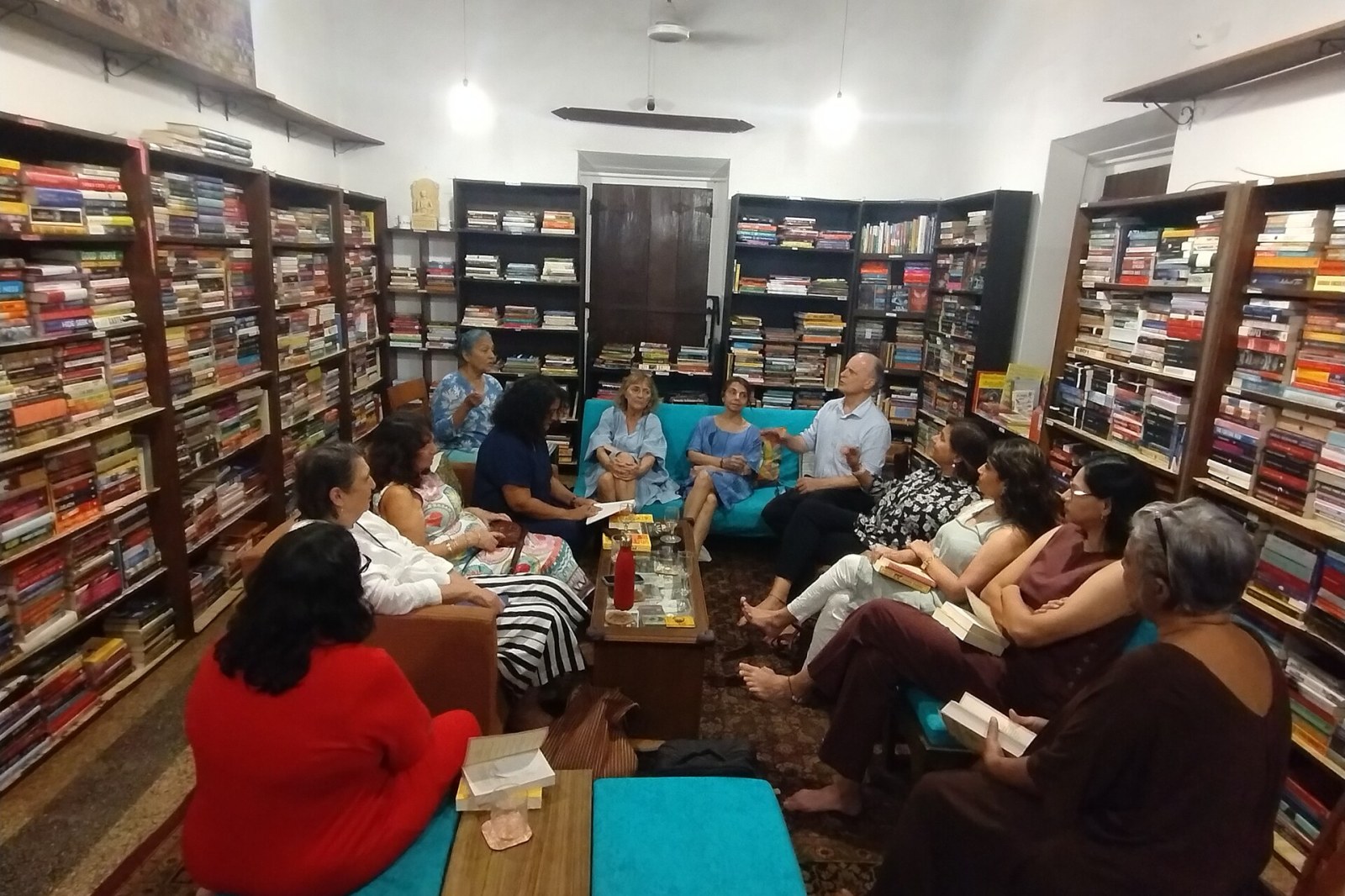
Cover photo: Frederick Noronha, "Book club meeting at the charming Literati bookshop in Calangute, Goa, 2026 05," CC BY-SA 4.0, via Wikimedia Commons.