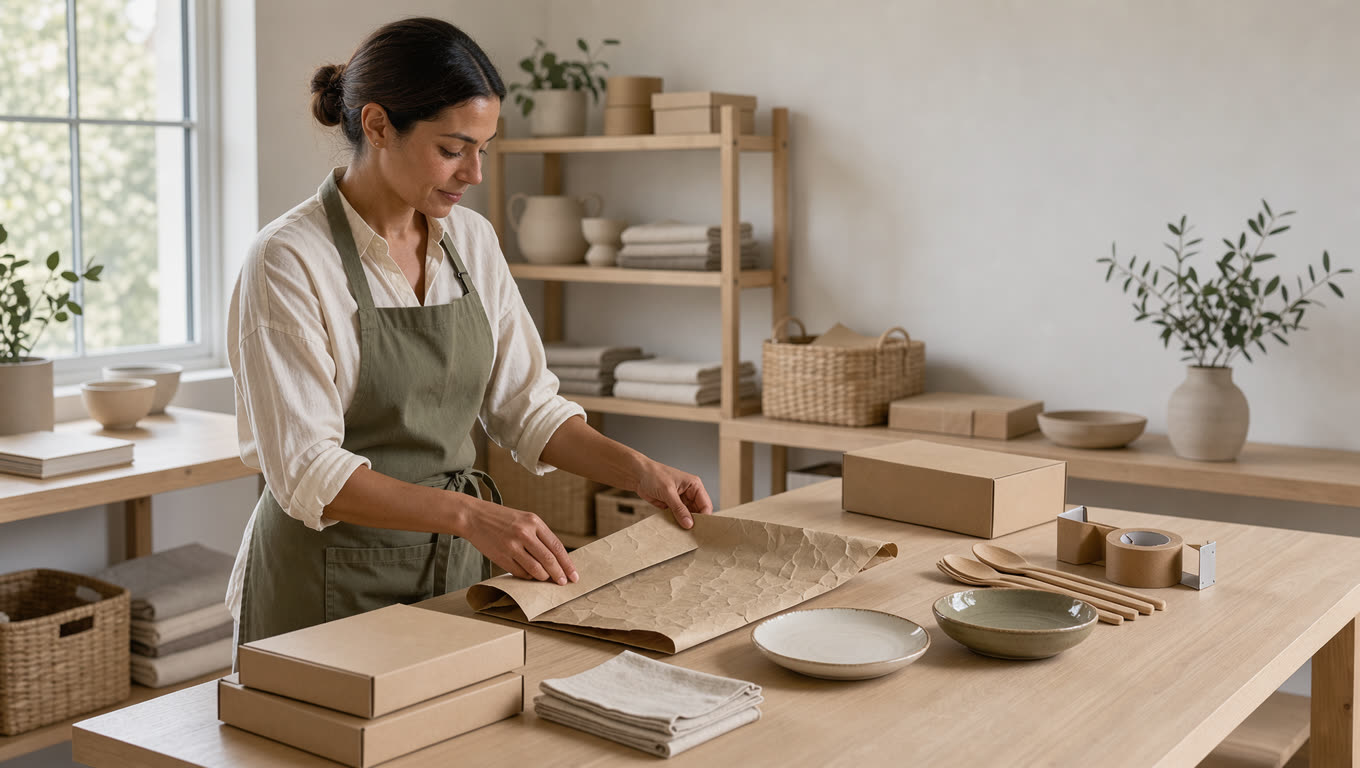
Launching a sustainable home goods brand in 2027 means building a business around kitchenware, textiles, decor or cleaning essentials that are made to last, sourced responsibly and packaged with less waste — and it is one of the few consumer categories where the growth data and the buyer intent point in the same direction. This guide walks through the exact steps: choosing a narrow niche, verifying suppliers and certifications, meeting the packaging rules that took effect in the EU in 2026, pricing without greenwashing, and choosing the right sales channels.
Table of Contents
- Why Sustainable Home Goods Is a Growth Market
- Choose Your Niche and First Product Line
- Find Suppliers and Materials You Can Verify
- Packaging and Compliance After the 2026 EU Rules
- Price Your Brand Without Greenwashing
- Where to Sell: Direct-to-Consumer and Selective Retail
- Frequently Asked Questions
- Conclusion
- Sources
Why Sustainable Home Goods Is a Growth Market
A sustainable home goods brand is a viable business in 2027 because the category is large, growing at double-digit rates, and supported by stated buyer willingness to pay more. Stratistics MRC values the global eco-friendly home products market at $446 billion in 2025, rising to $955 billion by 2032 — a compound annual growth rate of 11.5%. Within that, eco-friendly furniture alone was worth $53.7 billion in 2025 and is forecast to reach $113.9 billion by 2033 at a 10.0% CAGR, according to Grand View Research.
Demand is not just a projection; it shows up in what consumers say they will spend. PwC's 2024 Voice of the Consumer Survey, covering more than 20,000 consumers across 31 countries, found that 80% are willing to pay more for sustainably produced or sourced goods, at an average premium of 9.7%. At the same time, the same research environment exposes the category's weakness: only 20% of consumers believe brands communicate their sustainability initiatives accurately (Blue Yonder, 2025). The opportunity and the trap are the same — buyers want sustainable products, and they are sceptical of the claims. Winning brands pair real sourcing with specific, verifiable proof.
Choose Your Niche and First Product Line
The right first move is to pick one narrow product niche rather than a broad "eco home" catalogue, because a focused line is easier to source, to certify and to explain. Stratistics MRC segments the market into cleaning supplies, bedding and linens, kitchenware and tableware, home decor, and building and renovation materials — kitchenware, textiles and decor are the most approachable entry points for a founder, since they ship small, do not expire, and tolerate direct-to-consumer margins better than furniture.
Narrow further by material or use case: plastic-free food storage, organic cotton or linen bedding, solid wood or bamboo kitchen tools, refillable cleaning concentrates, recycled-glass lighting. Grand View Research notes that residential applications accounted for 54.4% of eco-friendly furniture sales in 2025 and that North America held 42.6% of the global market, so a North American or European launch targets the deepest demand pool. Start with three to five SKUs, one hero product and a small complementary set, and expand only after you can repeat your first sales without discounting. Founders who have already walked this path in adjacent categories — launching a sustainable fashion brand on a budget and building a handmade jewellery brand beyond Etsy — used the same narrow-first logic.
Find Suppliers and Materials You Can Verify
A credible supplier for a sustainable home goods brand is one that answers documented questions — material composition, certifications, factory audit, minimum order quantity and lead time — with paperwork rather than adjectives. Ask for certificate numbers and check them in the issuer's public database: FSC chain-of-custody codes for wood and paper, OEKO-TEX or GOTS scope certificates for textiles, and third-party social audit reports for the factory itself.
Certification is now a mainstream business practice rather than a niche badge: B Lab reports more than 10,800 Certified B Corporations across 102 countries as of June 2026, certifying under new, stricter standards published in April 2025 that verify performance across seven impact topics. Use that as your screening bar — suppliers who already hold recognised certifications have done the compliance work you would otherwise inherit. For materials, favour deadstock, recycled and rapidly renewable inputs, and request swatch samples and lab reports before committing to a production run. Build a second source for every critical material from day one; single-source suppliers are the most common cause of a small brand missing its launch window.
Packaging and Compliance After the 2026 EU Rules
If you sell into the European Union, your packaging obligations changed on 12 August 2026, when the Packaging and Packaging Waste Regulation (EU) 2025/40 — the PPWR — started applying directly in every member state, replacing the 1994 directive. The headline deadlines: all packaging placed on the EU market must be recyclable by 1 January 2030, and grouped, transport and e-commerce packaging may contain a maximum of 50% empty space, which directly constrains the oversized boxes and void fill common in online home goods shipping.
The same regulation requires member states to cut packaging waste per capita by 5% by 2030 against 2018 levels, and sets minimum recycled content for plastic packaging from 2030 — 30% for contact-sensitive PET packaging and 35% for other plastic packaging, rising in 2040. Separately, Directive (EU) 2024/825 on empowering consumers for the green transition has applied since 27 September 2026: generic environmental claims such as "eco-friendly", "green" or "nature's friend" are prohibited unless you can demonstrate recognised excellent environmental performance, and sustainability labels must be based on a recognised certification scheme. The practical design rule is simple — right-size the box, specify the material on the label, and replace vague adjectives with a specific, provable statement.
Price Your Brand Without Greenwashing
Price a sustainable home goods brand on delivered value and cost of goods, then support the premium with evidence — because the market will pay a premium but punishes unsupported claims. PwC measured an average willingness to pay 9.7% more for sustainably produced goods in 2024, and Blue Yonder's 2025 survey of more than 5,000 consumers found 78% say sustainability considerations matter when they choose a product, while 54% name the higher cost of sustainable products as their main barrier and only 20% trust what brands say about their initiatives.
Three pricing habits keep you on the right side of that data. First, quote the number: "made with 100% post-consumer recycled cotton" instead of "planet-friendly". Second, let a third party carry the claim — an FSC, GOTS or B Corp mark transfers trust you have not yet earned. Third, be transparent about what is not yet perfect; a brand that publishes its material percentages and its remaining gaps is judged more credible than one claiming perfection, which matters commercially as well as legally under the EU's greenwashing rules. Keep the sustainability language consistent across product pages, packaging inserts and wholesale linesheets, so a retailer reading your sheet hears exactly what your customer reads on your site.
Where to Sell: Direct-to-Consumer and Selective Retail
The strongest channel mix for a new sustainable home goods brand in 2027 is a direct-to-consumer store for margin and storytelling, plus selective independent retail for volume and credibility. Shopify reported $119 billion of gross merchandise volume in Q3 2026 alone, with revenue up 32% year over year, which confirms how much of the category's discovery now happens on independent brand storefronts rather than marketplaces.
For wholesale, the two-sided marketplace model has matured: Faire reported that its retailers and brands were expected to generate nearly $3 billion in GMV in 2025 at a $5.2 billion valuation, and by November 2026 the platform was reported to connect roughly 500,000 retailers with 100,000 brands while eyeing an IPO. Faire's own market data from July 2025 shows why this matters for you: "eco-friendly" was the top value tag used by buyers in the UK and Germany, ahead of "women-owned" and "not sold on Amazon". Independent shops are actively filtering for exactly your positioning. Start with a small, curated group of stockists you can service personally — design stores, zero-waste shops, hotel and gift boutiques — and treat each one as a show room for the next. If you want to test demand before committing to inventory at all, the subscription box model is a useful low-stock way to validate which products people reorder.
Frequently Asked Questions
How much does it cost to start a sustainable home goods brand?
The largest cost drivers are the first production run, packaging tooling, certification fees and product photography, not the company registration. Keep the first order small — a short run of three to five SKUs with a domestic or low-MOQ manufacturer preserves cash while you test which product actually sells, and it avoids the deadstock problem that destroys margins in home categories.
What actually makes a home goods product sustainable?
Four things: the material (recycled, certified or rapidly renewable), the durability (how many years of use it survives), the end of life (repairable, recyclable or compostable), and the conditions under which it was made. Since 27 September 2026, EU law also requires that any environmental claim you make about those attributes be specific and demonstrable rather than generic.
Do I need a certification to call my products eco-friendly?
In the EU you do not need a licence to describe a real, specific attribute — "packaging made from 100% recycled cardboard" is permitted — but a generic claim like "eco-friendly" without recognised excellent environmental performance is prohibited, and a sustainability label must be based on a recognised certification scheme. Certifications such as FSC, GOTS or B Corp are the practical way to comply and to be believed.
How do the new EU packaging rules affect a small brand?
The PPWR has applied since 12 August 2026 and binds anyone placing packaged products on the EU market, including small and online-only brands. The changes you feel first are right-sizing (no more than 50% empty space in e-commerce boxes), recyclable-by-2030 packaging, and recycled-content minimums for plastic from 2030 — all of which are cheaper to build into a new packaging design than to retrofit later.
Where is the best place to sell sustainable home goods in 2027?
Own storefront first — a Shopify shop gives you the customer relationship, the data and the full margin — then wholesale through independent retailers sourced on a marketplace such as Faire, where "eco-friendly" is already the leading buyer filter in the UK and Germany. Avoid racing to mass marketplaces where price comparison erases the premium you built the brand on.
How long before a sustainable home goods brand becomes profitable?
It depends on your production terms and channels: a small first run sold direct can cover its costs quickly, while a line built for wholesale needs repeat reorders from stockists before it carries itself. The practical sequencing is to prove the product direct-to-consumer, then use those sales as the evidence that convinces retailers to place opening orders.
Conclusion
Launching a sustainable home goods brand in 2027 is less about a green message and more about disciplined execution: a narrow niche you can source honestly, packaging that already meets the rules that took effect in 2026, pricing that states specific facts instead of adjectives, and a channel mix of your own store plus a curated set of independent stockists. The market data supports the effort — $446 billion in eco-friendly home products in 2025 heading for $955 billion by 2032, with four in five consumers willing to pay more — but the brands that win are the ones whose claims survive a customer's scrutiny. Start with three products, publish your sourcing, and let verification do the marketing.
Sources
- Stratistics MRC, Eco-Friendly Home Products Market Forecasts to 2032 (via The Market Research Store) — marketresearch.com
- Grand View Research, Eco-friendly Furniture Market Size, Share Report, 2026-2033 — grandviewresearch.com
- PwC, 2024 Voice of the Consumer Survey (published 15 May 2024) — pwc.com
- Blue Yonder, 2025 Consumer Sustainability Survey (published 25 March 2025) — businesswire.com
- GA-Alliance, PPWR in force: new EU packaging rules apply from 12 August 2026 — ga-alliance.eu
- EUR-Lex, Directive (EU) 2024/825 on empowering consumers for the green transition — eur-lex.europa.eu
- B Lab, Companies Achieve B Corp Certification Under New Global Standards (16 June 2026) — bcorporation.eu
- Faire, A Milestone for Faire (17 November 2025) — faire.com
- Faire, Faire Market by the Numbers, July 2025 — faire.com
- Fortune, Wholesale marketplace Faire survived the 'fog of crazy valuations.' Now, it's eyeing an IPO (2 November 2026) — fortune.com
- Shopify Q3 2026 results, Revenue Up 32% (3 November 2026) — shopify.com