The candle business is one of the few product businesses you can start from a home kitchen with a few hundred dollars, and it competes in a genuinely large market. Global candle revenue was valued at USD 11.0 billion in 2025 and is expected to reach USD 17.0 billion by 2034, growing at a compound annual rate of 4.83% (IMARC Group, 2026). This guide shows how to launch a candle business that actually sells: choosing a niche, working with fragrance and IFRA rules, costing your units honestly, pricing for margin, testing for safety, and building the year around the holiday selling peak.
Table of Contents
- Why the Candle Business Is Worth Starting in 2027
- Choose Your Niche, Wax and Product Formats
- Fragrance Loads and IFRA Compliance
- Startup Costs and Pricing for Real Margins
- Safety Testing, Labeling and Insurance
- Where to Sell: Your Own Store, Marketplaces and Wholesale
- Plan the Year Around the Holiday Peak
- Frequently Asked Questions
- Conclusion
Why the Candle Business Is Worth Starting in 2027
A candle business is worth starting in 2027 because demand is large, still growing, and spread across gifting, home decor and wellness rather than a single trend. IMARC Group valued the global candle market at USD 11.0 billion in 2025 with a forecast of USD 17.0 billion by 2034, and North America alone accounted for more than 32% of that market in 2025. In the United States specifically, the candle market was valued at USD 3.81 billion in 2025 and is projected to reach USD 5.38 billion by 2034, a compound annual growth rate of 3.90% (Market Data Forecast, 2026).
Three structural advantages make this a friendly category for a small maker. First, the product is small, non-perishable and cheap to ship, so inventory does not rot and storage is simple. Second, candles are bought as gifts all year, not only in December. Third, the barriers are low: no licence is required to sell candles in most U.S. states beyond a standard home-business registration, while differentiation lives in scent, story and packaging rather than in factory scale. If you want the same low-inventory logic applied to digital goods instead, see how to launch a digital products shop.
Choose Your Niche, Wax and Product Formats
You should choose your niche before you buy wax, because niche determines fragrance family, vessel, price ceiling and the audience you market to. The fastest-growing and most forgiving entry point is the container candle — a scented candle poured into a jar or tumbler — because the vessel protects the flame, the burn is cleaner, and the format reads as a giftable object on a shelf or a product photo.
On the wax itself, the three mainstream options each carry a trade-off:
- Soy wax — the default for artisan brands: slow burn, good scent throw, easy to source, and the fragrance load you can hold is typically 6–10% of the wax weight.
- Coconut and coconut-soy blends — creamier surface and stronger cold throw, but materially more expensive per pound, which pushes your retail price up.
- Paraffin — cheapest and the best scent throw of the three, still used by most of the large brands; a viable choice if you never market yourself as "natural".
Start with one wax, one vessel size and 4 to 6 fragrances rather than a 20-SKU catalogue. A tight range lets you test burn quality properly, keeps your first production batch cheap, and gives you a coherent story for the first stockists you approach — the same logic behind the lean launch described in launching a handmade jewelry brand.
Fragrance Loads and IFRA Compliance
IFRA compliance matters because fragrance is the one ingredient in your candle that can legally and medically go wrong, and because marketplaces and insurers increasingly ask for the paperwork. IFRA — the International Fragrance Association — publishes the IFRA Standards, a self-regulating system that bans, restricts or sets purity rules for fragrance materials; it is compulsory for IFRA members, who produce around 80% of the global volume of fragrance (IFRA, 2026).
Scented candles and wax melts fall into IFRA Category 12. Your supplier's IFRA certificate will usually show a limit of 100% or "no restriction" for that category — which does not mean you should pour 100% fragrance. It means IFRA sets no lower ceiling, and the real limit becomes what your wax can physically hold without sweating, tunneling and smoking: typically 6% to 10% for soy wax, 8–12% for coconut wax and 4–6% for beeswax. The current standard is the 51st Amendment, notified on 30 June 2023, which applies to existing creations since 30 October 2025, so ask every supplier which amendment their certificate reflects.
Practical routine: request an IFRA certificate and a safety data sheet for every fragrance oil you buy, keep them in a binder with your batch records, and re-check them whenever IFRA publishes a new amendment. If you also sell into the European Union, add CLP labelling (Classification, Labelling and Packaging) and a batch number under the GPSR, which has applied since 13 December 2024.
Startup Costs and Pricing for Real Margins
You can launch a candle business properly for USD 300 to USD 800 in equipment and first-batch materials, but profitability is decided by your per-unit cost, not your startup budget. The industry rule of thumb is that a well-priced 8 oz soy candle costs USD 4 to USD 6 in materials and sells for USD 16 to USD 22, giving a gross margin of 60–70% (Craftybase, 2026). That 60–70% figure is a materials margin: once labour, packaging, platform fees and shipping supplies are counted, a realistic total cost per candle lands around USD 12.80, which turns a USD 20 sale into roughly USD 7.20 of net profit — about 36% (SpeedCalcs, 2026).
Price from a full cost sheet: wax, fragrance, wick, vessel, lid, label, dust cover, shipping box, your labour at an hourly rate, and the platform fee you will actually pay. Then check the result against the channel:
- Direct to consumer: aim for a total cost of goods at or below 30–38% of retail, leaving room for marketing.
- Marketplace: Etsy-style fees in 2026 run about 6.65% plus a fixed listing charge, before payment processing (SocCash, 2026).
- Wholesale: retailers expect roughly 50% off retail, so your cost sheet must survive being halved — which is why many makers keep a simplified "wholesale SKU" with cheaper packaging.
A useful sanity check is the break-even unit count: with USD 600 of monthly fixed costs, a USD 12.50 contribution per candle and a USD 21 price, you need 48 candles a month before you pay yourself. The same discipline applies to any small product business; our freelance data analysis guide covers the cost-sheet method in more depth.
Safety Testing, Labeling and Insurance
You need safety testing and insurance because a candle is a live flame sold to the public, and because one claim can end the business. In the United States, fire departments responded to an estimated average of 5,894 home structure fires per year whose heat source was candles over 2020–2024, causing 63 civilian deaths, 532 injuries and USD 286 million in property damage annually (NFPA, 2025). More than half of those fires began when a flammable decoration was too close to the lit candle.
Your defence is a documented product file rather than good intentions:
- Burn testing: test every fragrance and wick combination in the exact vessel you sell, record burn time, flame height, soot and melt pool, and only then fix the recipe.
- Standards: the U.S. reference is ASTM F2417 (fire safety of candles), with ASTM F2058 for cautionary labelling and ASTM F2179 for glass containers; in the UK and EU the equivalents are EN 15493, EN 15494 and EN 15426.
- Warning labels: never leave a burning candle unattended, keep away from children, pets and anything that burns, plus your business name and net weight.
- Product liability insurance: boutique buyers and wholesale platforms routinely ask for USD 1–2 million of cover, and premiums typically run a couple of thousand dollars a year.
Put "burn safely" guidance in every order — it protects customers and doubles as content. If you plan seasonal gift ranges, the compliance pattern is identical to the one used in launching a greeting card brand.
Where to Sell: Your Own Store, Marketplaces and Wholesale
You should sell candles through three channels at once — your own store for margin, a marketplace for discovery, and a small number of stockists for credibility — because no single channel is stable enough to carry the business alone.
- Your own store (Shopify or a similar platform): highest margin, full customer data, and the only place you own the relationship. This is where your email list lives.
- Marketplaces (Etsy, Amazon Handmade): immediate traffic and a ready-made gifting audience, at the cost of fees and algorithm risk.
- Wholesale (Faire and independent boutiques): Faire charges North American brands a 15% commission on marketplace orders plus a one-time USD 10 fee on a new retailer's first order (Faire Help Center, October 2026). Stockists give you volume, predictable reorder cycles and a logo you can show.
Whatever the mix, photograph the product once, properly: clean background, natural light, the label legible, and a lifestyle shot with the candle lit. Social channels — Instagram and Pinterest above all — remain the cheapest way to feed every one of these channels, as covered in our social media management studio guide.
Plan the Year Around the Holiday Peak
You must plan the year around the holiday peak because roughly 35% of all candle sales in the United States occur during the Christmas and holiday season, with the remaining 65% spread across the rest of the year (National Candle Association, 2026). A candle business that improvises in November loses the largest margin window of its year.
Work backwards from December: your fragrance and vessel orders placed in August, production runs in September and October, photographs and gift-set listings live by early October, and wholesale catalogs in front of buyers at least 60 days before the season. December is also the peak month for candle fires, so holiday bundles are the right moment to include a safety card. Outside the gifting window, sustain the 65% with wedding and event orders, corporate gifting, and a replenishment offer on your own store — the seasonality playbook in our baking business guide transfers almost one-to-one.
Frequently Asked Questions
How much does it cost to start a candle business?
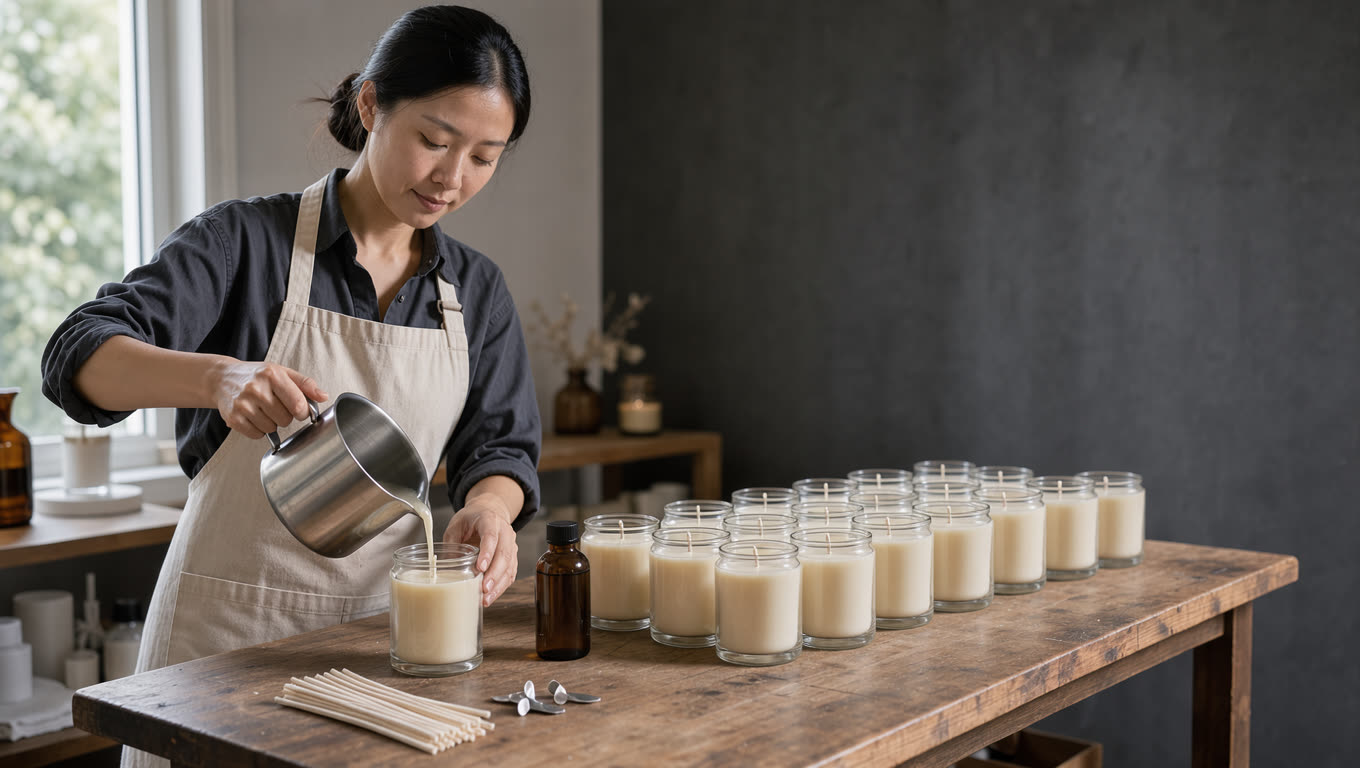
A practical launch — a pouring pot, a digital scale, a thermometer, a heat source, jars, wicks, wax, fragrance and labels for a first batch of 30 to 50 candles — typically runs USD 300 to USD 800. Adding burn-testing supplies, product photography and basic insurance usually brings the real first-year figure closer to USD 1,500.
How much profit is there in a candle?
Gross margin on materials is commonly 60–70% on an 8 oz candle priced at USD 16–22, but after labour, packaging, platform fees and shipping, net profit is closer to 36–49% per unit. Wholesale at roughly half of retail compresses that further, so volume and channel mix decide the outcome.
Do I need a licence or certification to sell candles?
No U.S. federal licence is required to make and sell candles, but you normally need a home-business or seller's permit for sales tax, and some states or cities add registration. Certification is voluntary — the documents buyers ask for are IFRA certificates, safety data sheets and proof of product liability insurance rather than a candle-making diploma.
What fragrance load should I use in a soy candle?
Start at 6–8% of the wax weight for soy and increase only if the cold and hot throw stay weak. The IFRA certificate for Category 12 often allows far more, but the wax itself — not IFRA — is your practical ceiling, and going past it causes sweating, tunneling and soot.
How long should I cure candles before selling them?
Soy candles generally need a minimum of 3 to 4 days and up to two weeks of cure time before the fragrance binds properly and the throw is at its best. Build the cure period into your production calendar so that you never ship a batch the day it is poured.
When should I start preparing for the holiday season?
Start in August: ingredients and vessels ordered in late summer, production in September and October, listings and gift sets live by early October, and wholesale catalogs sent out at least 60 days ahead. About 35% of U.S. candle sales land in the Christmas and holiday season, so a two-month lead is the minimum.
Conclusion
A successful candle business in 2027 is not the one with the prettiest jar — it is the one that costs every unit accurately, holds IFRA paperwork on file, tests each burn, prices for a real margin instead of a materials margin, and reaches the holiday window fully stocked. Start with a narrow range, one wax and four to six fragrances; sell through your own store plus one marketplace; add a couple of stockists once your cost sheet survives a 50% wholesale discount. Do that consistently and you are building a brand in a market growing toward USD 17 billion — with the seasonality planned rather than improvised.
Sources
- IMARC Group — Candle Market Size, Share, Growth & Analysis Report 2034 (market valued at USD 11.0 billion in 2025, USD 17.0 billion by 2034, CAGR 4.83%; North America above 32% share)
- Market Data Forecast — United States Candle Market, 2026–2034 (U.S. market USD 3.81 billion in 2025, USD 5.38 billion by 2034, CAGR 3.90%)
- National Candle Association — Facts & Figures (approximately 35% of candle sales occur during the Christmas/holiday season)
- NFPA — Safety with Candles (2020–2024 annual averages: 5,894 home fires, 63 deaths, 532 injuries, USD 286 million in property damage)
- IFRA — Understanding the Standards (standards compulsory for IFRA members, about 80% of global fragrance production volume)
- Naturcera — Selling candles in the EU: GPSR, CLP and IFRA explained (Category 12 for candles, 51st Amendment notified 30 June 2023 and applicable to existing creations since 30 October 2025, GPSR since 13 December 2024)
- Petalmade — IFRA Compliance for Candle Makers (fragrance loads by wax type: soy 6–10%, coconut 8–12%, beeswax 4–6%; retailer and insurance expectations)
- Craftybase — Is Candle Making Profitable? The Real Margins Explained (8 oz soy candle: USD 4–6 to produce, USD 16–22 retail, 60–70% gross margin)
- SpeedCalcs — Is Candle Making Profitable? The Real 2026 Numbers (total unit cost about USD 12.80, ~36% net margin at USD 20)
- SocCash — Candle Making Profit Margins 2026 (COGS 32–38% of revenue, Etsy fee benchmark 6.65% + USD 0.25)
- Ginger Brands — Faire Wholesale: How to Sell on Faire (2026 Guide) (15% commission on marketplace orders plus USD 10 new-customer fee, per Faire's Help Center, October 2026)
- Bramble Berry — How to Make Soy Wax Candles (recommended cure time of 3–4 days minimum, up to 2 weeks)