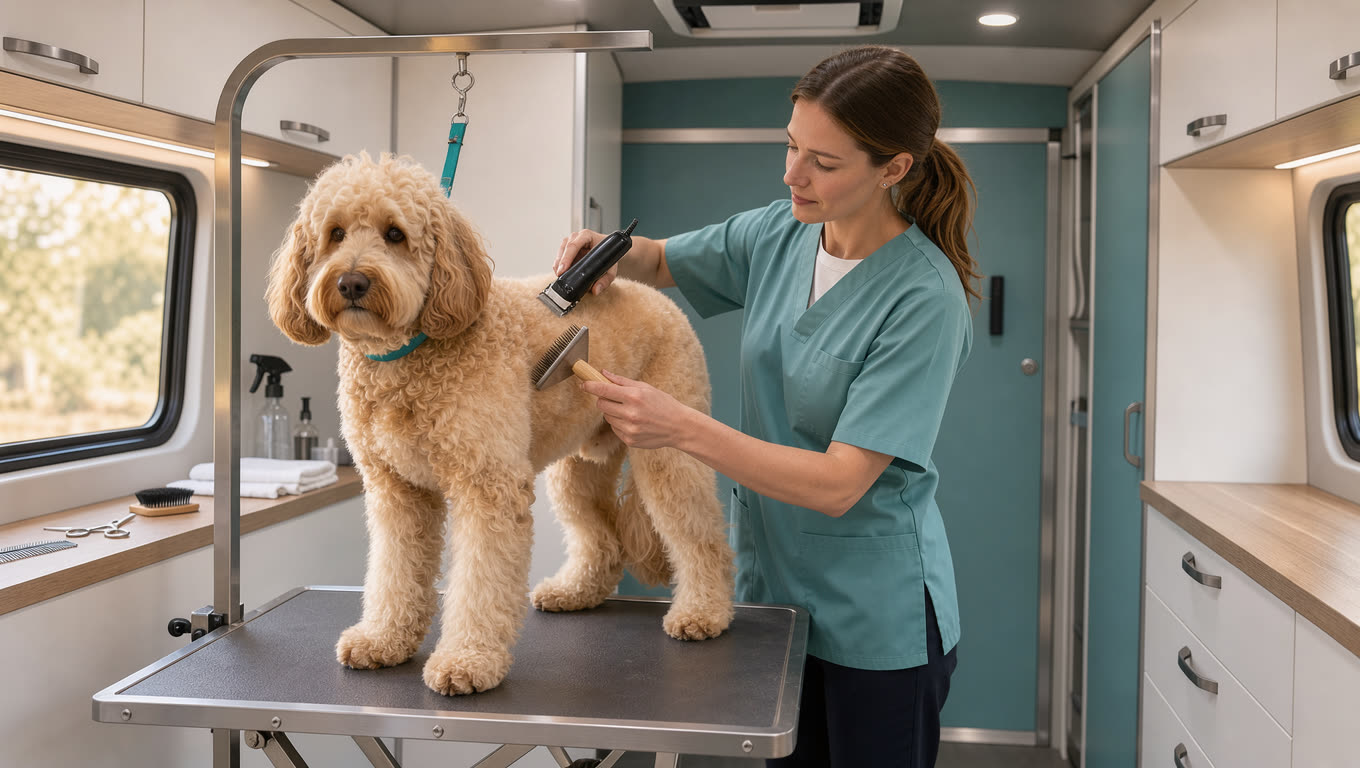
Starting a pet grooming business in 2027 is one of the more affordable service businesses to launch, and one of the easiest to run badly. The U.S. pet grooming services market was worth USD 2.19 billion in 2025 and is forecast to reach USD 3.23 billion by 2031, a 6.67% compound annual growth rate (Mordor Intelligence, 2026).
This guide covers the four decisions that determine whether a new grooming operation survives its first year: how to get trained and certified, whether a converted van is worth the money, how to price by breed, and how to keep clients rebooking every six to eight weeks instead of drifting away.
Table of Contents
- Why pet grooming is a strong business in 2027
- Training and certification: what you actually need
- The van route: what a mobile setup costs
- Pricing by breed: how much to charge
- Customer retention: the real profit engine
- Common mistakes to avoid
- Frequently Asked Questions
- Conclusion
Why pet grooming is a strong business in 2027
Pet grooming is a strong business in 2027 because demand is recurring by nature: most dogs need a professional groom every 6 to 12 weeks, so revenue compounds from repeat visits rather than one-off sales. The numbers back it up — U.S. pet industry expenditures reached $158 billion in 2025, up 3.7%, and are projected at $165 billion for 2026 (APPA, 2026 State of the Industry Report), with 95 million U.S. households owning at least one pet and 71 million owning a dog.
Grooming sits inside APPA's "other services" category — boarding, grooming, insurance, training, pet sitting and walking — worth $14.3 billion in 2025 and projected at $14.9 billion for 2026 (APPA). Grand View Research values U.S. grooming services at $2.06 billion in 2024, growing at a 6.7% CAGR to $2.99 billion by 2030. Two shifts matter for a newcomer: mobile and at-home grooming is the fastest-growing delivery channel at 8.35% CAGR through 2031, and cats are the fastest-growing pet type (Mordor Intelligence, 2026).
The counterweight is real: APPA's 2026 Dog Report found that 51% of U.S. dog owners groomed their dogs at home in 2025. You compete with the salon down the road and with owners wielding a slicker brush — skill and convenience are what make DIY look like a chore.
Training and certification: what you actually need
You do not need a state license to become a professional dog groomer: as of 2026, no U.S. state requires an individual grooming license, so you can legally pick up clippers with zero credentials (Groomerjob, 2026). What you do need is hands-on hours and a local business license — plus a facility license in a few states, about $100 a year in Connecticut and $350–$400 in Colorado.
Training routes span three budgets. An online-plus-mentored route such as Paragon starts at $1,299 per level; a full externship program such as Animal Behavior College runs $3,499–$5,647 over 12 months; a self-paced online certificate costs around $649 (Groomerjob). Paid salon academies at Petco and PetSmart cost nothing upfront but lock you into employment, and most groomers reach full proficiency after one to two years of training plus salon experience.
Certification is optional but pays: certified groomers earn an estimated 20–30% more than uncertified peers. The best-known credential is the AKC Professional Grooming Credential (PGC): exam fee $179.99, renewed every five years, requiring 360 hours of verifiable experience in 18 months — or 25 hours of education plus 180 hours of salon work (AKC). Insure from day one: mobile groomers pay a median $65 per month for general liability, $80 for a business owner's policy and $245 for commercial auto (Insureon, 2025).
The van route: what a mobile setup costs
A converted grooming van is the most expensive way to start a pet grooming business: budget $56,000 to $153,000 all-in for the vehicle, equipment, plumbing, permits, insurance and working capital (Wexford Insurance, 2025). The vehicle alone ranges from $85,000–$130,000 for a new turnkey van, $55,000–$85,000 for a used retrofitted one, $50,000–$70,000 for a DIY cargo van build-out, and $40,000–$70,000 for a grooming trailer that needs a separate towing vehicle.
On top of that, professional equipment runs $5,000–$15,000 — grooming table, stainless steel tub, high-velocity dryer, clippers, generator and water tanks. Specialists such as Wag'n Tails still build purpose-built mobile salons today (site verified November 2026), often with down-payment matches and manufacturer rebates that cut the entry price by several thousand dollars.
The upside justifies the outlay for the right operator: mobile and at-home grooming is the market's fastest-growing channel, forecast at an 8.35% CAGR through 2031 (Mordor Intelligence), and a van lets you charge a convenience premium while serving one client per slot with no waiting room. The prudent path for a first-time owner is smaller: start with a trailer or a rented booth, prove you can fill 6–8 grooms a day for three months, then upgrade.
Pricing by breed: how much to charge
Price by breed size and coat condition, not with a single flat rate: the national average full groom is $85, but small breeds average $62, medium $77, large $95 and giant breeds $120 (Bark, 2026 price guide). A standard full-service groom for an average dog with a medium coat lands at $60–$100, while a long-coat full groom with dematting and styling runs $60–$120 (PawListed, 2026).
Breed schedules drive lifetime value more than the ticket price. A Goldendoodle groomed every 6–8 weeks at $85–$150 per visit costs its owner $700–$1,300 a year; a Shih Tzu every 4–6 weeks costs $600–$950; a Beagle every 8–12 weeks costs only $175–$300 (PawListed). Build your price list around three tiers — short coat, long or curly coat, double coat — and publish add-ons separately: de-shedding treatment $15–$40, nail trim $12–$25, teeth brushing $8–$15. Never absorb matted-coat time into the base price; a dematting surcharge is the industry norm and it protects your schedule.
Customer retention: the real profit engine
Retention is the profit engine of a pet grooming business, and the single biggest lever is rebooking at checkout. Groomers who consistently ask before the client leaves report 70–80% prebooking rates; those who don't ask hover around 30–40% (The Daily Groomer, 2026). A 70% rebooking rate is considered excellent, 50–70% is solid, and below 50% means you are buying your own clients back with advertising.
The mechanics are simple. Ask every time with a positive assumption — "Would you like to schedule Bailey's next appointment before you go?" — and pull up the calendar in front of the client. Automate reminders: a confirmation at booking, then 48-hour and 24-hour texts, which reduce no-shows by 30–50% (The Daily Groomer). Track four numbers monthly — rebooking rate, average visit interval, annual visits per client and no-show rate. Moving a client from a 12-week gap to a 7-week gap adds roughly one extra appointment a year: across 100 clients, that is 100 grooms you currently never see.
Retention also compounds into referrals: happy owners of a well-groomed dog are the same people who need dog walking, boarding or daycare. If you are building a wider pet-care portfolio, our guide on starting a pet sitting and dog walking business covers how to package those services together.
Common mistakes to avoid
The mistakes that kill a new pet grooming business are predictable, and all four are avoidable. Underpricing double coats is the first: a Husky de-shed can double an appointment's length, and charging Beagle money for Husky work loses money on every booking. Skipping insurance is the second — at $65–$80 per month, it is the cheapest line item in your budget.
Buying the van before validating demand is the third: $80,000 of fixed cost in month one turns a slow start into debt service. Start lean, then upgrade. Ignoring the rebooking rate is the fourth: owners who leave without a booked appointment become "I'll call later" clients, and later rarely happens.
Frequently Asked Questions
How much does it cost to start a pet grooming business?
A mobile operation costs $56,000–$153,000 all-in (Wexford Insurance, 2025). A home-based or booth-rental setup starts far lower: training $500–$5,600, equipment $5,000–$15,000, liability insurance from $65 per month.
Do I need a license or certification to groom dogs professionally?
No U.S. state requires an individual grooming license as of 2026, so you can start with zero credentials. You still need a local business license, plus a facility license in some states — about $100 a year in Connecticut, $350–$400 in Colorado. The AKC PGC exam ($179.99) is voluntary but associated with 20–30% higher pay.
How much should I charge for a full groom?
Charge $60–$100 for a standard full groom, national average $85 (Bark, 2026). Tier by size: small $62, medium $77, large $95, giant $120. Long-coat grooms run $60–$120; price de-shedding ($15–$40) and nail trims ($12–$25) separately.
Is a mobile grooming van more profitable than a salon chair?
Mobile grooming commands a convenience premium and is the fastest-growing delivery channel at an 8.35% CAGR through 2031 (Mordor Intelligence, 2026). But it carries $56,000–$153,000 of startup cost and $245 a month in commercial auto insurance, so upgrade only once you can fill 6–8 grooms a day.
How often should clients rebook their dog?
Every 6–8 weeks for most coats, 4–6 weeks for fast-growing coats like Yorkies and Shih Tzus, 8–12 weeks for short-coat breeds (PawListed, 2026). Recommend the breed-specific window at checkout and book it before the client leaves.
What are the biggest risks in a pet grooming business?
Three dominate: underpricing time-consuming coats, carrying fixed cost before demand is proven, and losing clients to forgetfulness — automated reminders cut no-shows by 30–50% (The Daily Groomer, 2026). Liability cover at $65 a month is non-negotiable.
Conclusion
A pet grooming business in 2027 rewards the operator who sequences the fundamentals: train your hands first, keep fixed costs low until your calendar is full, price by breed instead of by guesswork, and treat the thirty seconds at checkout as the most valuable moment in your business. The market is growing at 6.67% a year and 71 million dog-owning households are already conditioned to pay for care. Do the boring things — rebooking, reminders, insurance, a published price list — and the growth takes care of itself.
Sources
- Mordor Intelligence — U.S. Pet Grooming Services Market (2026–2031)
- APPA — U.S. Pet Industry Reaches $158 Billion in 2025 (2026)
- APPA — Industry Trends and Stats
- Grand View Research — U.S. Pet Grooming Services Market, 2030
- Groomerjob — Dog Grooming Certifications & Costs (2026)
- AKC — Dog Groomer Hub, Professional Grooming Credential
- Wexford Insurance — Cost to Start a Mobile Dog Grooming Business (2025)
- Insureon — Mobile Pet Grooming Insurance Cost
- Bark — Dog Grooming Costs 2026
- PawListed — Dog Grooming Cost Guide (2026)
- The Daily Groomer — Client Retention Strategies
- Wag'n Tails — Mobile Grooming Vans (verified November 2026)